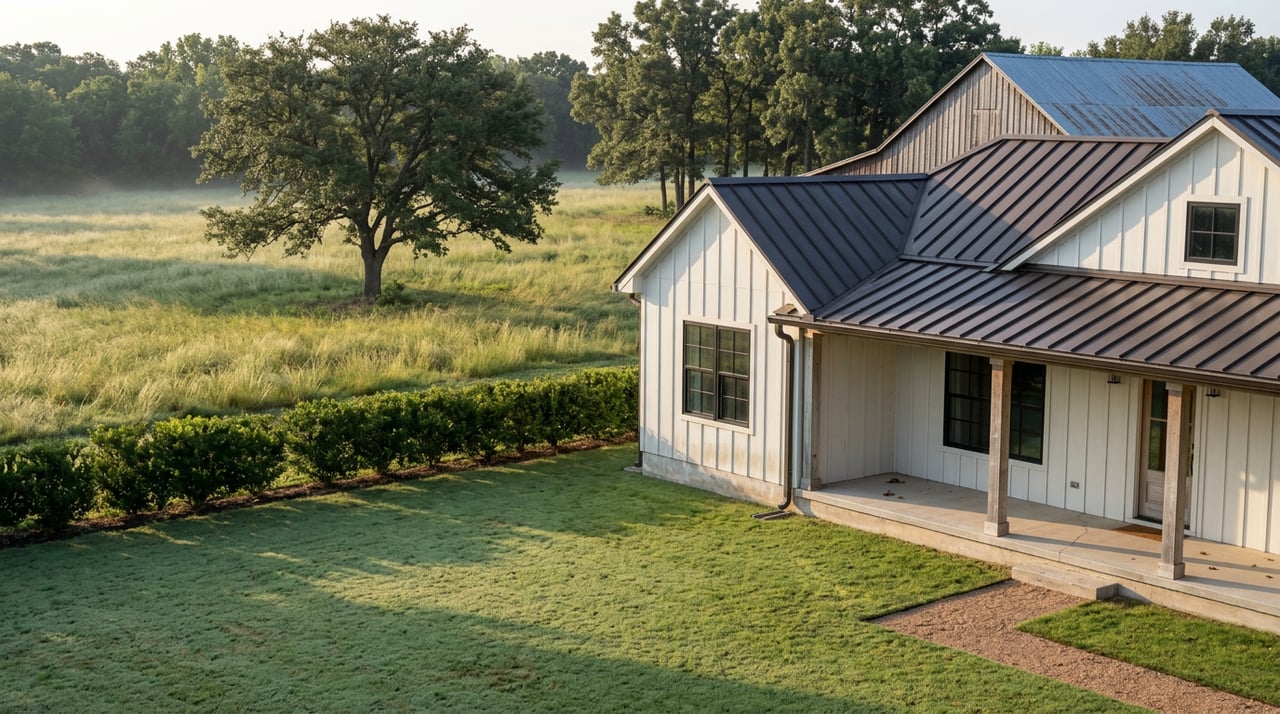
Walk a fence line with a seller during a private showing on any acreage tract outside Bellville and you'll likely hear some version of the same line: "We've always been closed range out here." It's said with total confidence, usually while gesturing at a sagging three-strand fence that separates the property from the neighbor's cattle. The buyer nods. Everyone assumes the question is settled.
Call the Austin County Clerk's office and ask for the document that says so, and the confidence disappears. Not because the clerk is unhelpful. Because in most Texas counties, that document doesn't exist in any form you can request over the phone, and if it exists at all, it's buried in commissioners' court minutes that may be a century old, may cover only part of the county, and may apply to some animals and not others.
That gap between what everyone says and what anyone can prove is the actual fence question in Austin County. It's not whether livestock can run loose here. It's whether you can find the paperwork that tells you the real answer for your specific tract, your specific road, and the specific animals your neighbor keeps.
Why "We've Always Been Closed Range" Isn't Proof of Anything
Texas operates on a fence-out doctrine by default. An 1893 Texas Supreme Court ruling established that livestock owners have the right to let their animals run at large, which means the burden falls on the landowner who wants animals kept off their property to build a fence sufficient to keep them out. That's been the baseline rule for over 130 years.
Since 1876, the Legislature has let individual counties change that baseline through a local stock law election, a vote that flips a county or part of a county from open range to closed range, shifting the fencing burden onto the livestock owner instead. Most of these elections happened in the early decades of the 1900s. Here's the problem: there is no statewide registry of which counties held these elections, when, or for which animals. The Texas State Law Library's own guidance points researchers to commissioners' court minutes and old election canvasses as the only real record. Private law firms have compiled unofficial charts by combing through what public records they could find, and even those firms note their compilations are incomplete and carry no guarantee of accuracy.
The Texas and Southwestern Cattle Raisers Association reported that as of 2011, only 23 Texas counties remained open range across the board. That means most Texas counties have adopted some form of stock law somewhere within their borders. It does not mean the rumor you heard at the fence line applies to your parcel. It might apply to a different precinct. It might apply to cattle but not horses. It might have never been formally adopted at all, just assumed into local memory because a stock law passed one county over.
The Same County Can Be Closed for Cattle and Wide Open for Horses
Texas Agriculture Code Chapter 143 doesn't treat livestock as one category. Horses, mules, jacks, jennets, donkeys, hogs, sheep, and goats fall under one set of election procedures. Cattle and domestic turkeys fall under a separate set. A county or precinct can vote to close the range for one class of animal and leave the other wide open, and the Texas Attorney General has previously flagged that stock laws passed without following the correct procedure for the specific animal at issue may not even be valid.
Geography fractures it further. Knox County is a documented example of exactly this kind of split: the northern part of the county never held a stock law election at all, while the southern half did. That's not a hypothetical. It's a real illustration of how a single county line means nothing once you get down to the precinct level.
A tract you're buying to run a couple of horses and a tract three miles away running cattle can sit under completely different fencing rules, even inside the same county, even along the same rural road. Assuming one settles the other is the mistake that costs people money.
A property fronting a state highway plays by a different rulebook than the exact same fence line two miles down a farm-to-market road, no matter what the county decided a century ago.
State Highways Are Closed Range by Law. Farm to Market Roads Are Not.
Austin County sits along Interstate 10 and U.S. Highway 290, both of which fall under a separate statute entirely. Texas Agriculture Code Section 143.102 makes every U.S. and state highway in Texas closed range for livestock, full stop, regardless of whatever a county's local stock law election decided. An owner who knowingly lets a horse or a cow wander onto I-10 or Highway 290 is exposed to liability no matter what county records show.
That statewide mandate does not extend to farm-to-market roads. Austin County has plenty of them, including roads like FM 1486, FM 159, and FM 1094, the same road that runs through the junction near New Ulm. Over 40,000 miles of farm-to-market road in Texas remain governed by whatever local stock law status applies, not by the automatic highway rule. So a tract fronting a state highway and a tract fronting an FM road a mile away can carry opposite fencing realities, even though both sit inside the same county and both would get the same shrug from a neighbor who tells you "we've always been closed range."
If your due diligence stops at "what does the county say" without checking which category your road frontage falls into, you haven't actually answered the question.
Fencing In or Fencing Out Doesn't Answer Who Pays
Even once you know whether your area is open or closed range, that only tells you who has the legal duty to build a fence. It says nothing about who pays for the one that's already there.
Texas has no universal rule requiring neighboring landowners to split the cost of a shared boundary fence. In a closed range area, a livestock owner who fails to contain their animals can be held liable for damage those animals cause. That doesn't mean the neighboring landowner can force the livestock owner to split the cost of a fence that mainly benefits the livestock operation. The reverse is also true. Absent a written agreement between the parties, cost sharing on a boundary fence is a matter of negotiation, not statute.
That matters directly for anyone buying acreage near Bellville with an existing boundary fence built by a previous owner or the neighboring rancher. You inherit the fence. You don't automatically inherit any enforceable claim to make someone else maintain it, and neither does the rancher next door get to send you a bill without your agreement to one.
What This Actually Means Before You Sign
For a buyer or seller working through a rural acreage transaction near Bellville, the fence question isn't something to leave for after closing. A workable sequence looks like this:
- Contact the Austin County Clerk's office and ask specifically whether a stock law election exists for the precinct your tract sits in, and for which animals it covers.
- Confirm the road classification for your property's frontage. A state highway carries the automatic closed range rule under Section 143.102. A farm-to-market or county road does not.
- Ask the seller directly whether any written boundary fence agreement exists with adjoining landowners, and get a copy if one does.
- If the county can't give you a documented answer, treat that silence as information, not reassurance, and consider having a local attorney confirm the election history before you rely on it in a purchase decision.
- Put whatever you find in writing as part of your file, not as a verbal understanding carried over from the showing.
None of this is paperwork for its own sake. Texas rural land closed 2025 at a record $7,704 per acre across the Austin-Waco-Hill Country region, according to Texas Farm Credit's land pricing guide, and statewide rural land prices rose 6.02 percent year over year to $5,246 per acre as of the first quarter of 2026, per the Texas Real Estate Research Center. On acreage priced at that level, a fencing assumption that turns out wrong isn't a minor inconvenience. It's a real dollar exposure on one of the largest purchases most buyers will make.
The fence line itself won't tell you any of this. Only the paper will, and finding the right paper is the part most buyers skip.
If you're weighing acreage near Bellville and want someone who already knows which questions the county can and can't answer, talk to a local land expert today at Bill Johnson Real Estate. We've spent decades walking these fence lines with buyers and sellers, and we'd rather find the paperwork gap with you now than let it surface at closing.